Thursday, 15 December 2011

Pre Production - Pre Mix Process


The first stage of the mixing process was to import the session data from the drum recordings so that it was in the same pro tools session as the guitar and bass recordings.

From there, it was necessary to synchronise the recordings from both sessions, ensuring the appropriate drum recording was playing alongside the appropriate guitar and bass recordings. Whilst this is not difficult, it is frustrating and time consuming, and is something I am hoping and planning to avoid having to do on my actual recordings.


It was then necessary to go through the session and remove unimportant recorded material, such as discussions within the studio or moment where no-one was playing or the musicians were not playing as a band, making the session data useless to me.


From there, the remaining session data was listened to and the poor quality performances were removed.


The remaining recordings were put on there own tracks and listened to individually in order to decide which would me mixed.

In the end, 2 recordings of a "loose jam" played by the band were selected to be mixed for pre production, as they were the best performances from the session.

Update

Have been unable to do any worth while work for the last week or so as my computer has been unusable, however, this has now been remedied and today I have done the first few steps towards creating the media i will hand in as part of pre production.

Saturday, 3 December 2011

Project Proposal

I have complete a (hopefully) final draft of my project proposal which I intend to email to Robin in the hopes that he can give me some critical feedback, below is the proposal as it is at present.


1. Abstract (Approx 250 words)
The aim of my project is to carry out recordings of a live band within a studio environment in order to determine how tracks of this sort are perceived in contrast to conventionally executed recordings.
The first stage of this project will be to look into both live and studio recording techniques, in order to determine which of these are applicable to my project. I will also carry out research into music producers and engineers who use or have used recording practices similar to those I am attempting to employ, such as Steve Albini who employs a more artist based recording practice (S. Albini, 2011). I will the write a literature review based upon the information I find on these producers and engineers in order to determine what particular recording practices and techniques may be applicable to my project.
From this stage, I will execute the practical part of my project. This will be a 3 track EP of musicians performing live, being recorded simultaneously within a studio environment.
This will then be contrasted against, pre existing, conventionally produced recordings of the same musicians, performing the same songs. This will be achieved by asking members of the public to complete listening tests, involving the 2 different versions of 1 of the songs, before completing a questionnaire which will aim to determine which version they preferred as well as providing an insight as to why this was the case.
These results will then be used towards completing a dissertation which will discuss the process by which the recordings where created as well as collating all the results to conclusively determine how people perceive a recording of this and why, which will in turn allow us to establish whether or not this is a method of recording which could be applied in a professional capacity in the future.
2. Project Aim and Objectives


The aim of my project is to carry out recordings of a live band within a studio environment in order to determine how tracks of this sort are perceived in contrast to conventionally executed recordings.

Objectives:

  1. To research recording, mixing and editing techniques within both live and studio recording environments and evaluate the practical applications of these in relation to my project.

    1. Research musical performance, studio recording, live recording, perception of music as well as looking at commercial examples where similar techniques have been used and the engineers and producers responsible.
    2. Write a literature view based on published works in a similar field to my own research

  1. To execute a recording of a full, live band, simultaneously within a studio environment and then produce a mix of this track.

    1. Set up microphones and recording equipment according to plan.
    2. Carry out several recordings, to permit me to choose the best performance by the band to mix
    3. Mix the recordings using conventional mixing techniques, whilst avoid editing the session data.


  1. To develop a survey based around this recording, in order to establish peoples perceptions of recordings of this sort.

    1. Research survey types in order to determine which can be most effectively applied to my project.
    2. Develop a survey based on my research in the area which will allow me to determine peoples perceptions of my recordings when compared to a conventionally carried out recording.
    3. Carry out this survey on as wide a variety of people as is possible in order to collate the most accurate results possible.
    4. Use these results the thoroughly answer the research question.

3. Rationale


Historically, music was recorded as a live performance, with all musicians simultaneously playing the music in a studio or live environment, whilst being recorded directly on to tape. This was changed with invention of multitrack recording, which arguably can be traced to Ampeg's “Octopus” in 1957, which was built to the specifications of Ross Snyder and owned by guitarist, Les Paul, (R.H. Snyder, 2003). Since this, it has become more common practice to record each element of the band separately. This allows each instrument to be isolated, allowing the producer to adjust or even correct the sound creating during the recording without affecting the rest of the song as a whole, over a long period of time, as is detailed by Richard Buskin when discussing the role Bill Bottrell played in the recording of Michael Jackson, Black or White (R. Buskin, 2004).


There are few producers who do not follow this practice of recording each element of the track in isolation. One such example is Steve Albini, a musician turned sound engineer, best known for his work with The Pixies, PJ Harvey and Nirvana, who tries to bring his experience from recording as a member of a band to his practices as an engineer (A. Young, 2004). Albini states “as much as possible we try to have it be like a natural normal experience for the bands”, by which he means that bands generally play live and as a collective and have a general set up, and comfortable placement when playing in relation to one another (S. Albini, 2010). It could also be derived from this statement, that since bands rehearse as one and perform as one, that having them record as separate entities is counter intuitive to the musicians, and may actually impede their performance.


This project aims to deviate from the conventional modern recording methods, of complete isolation of every element, as much as is practical. Instead, the project recordings will lean more toward historical recording methods or even those of Steve Albini, however, the project will be using digital equipments, which is not the case in either of these examples.


The recordings will subsequently be used to determine how people perceive recordings of this sort when compared to conventionally carried out, modern recordings.


The recording should make it possible to determine if this is a viable way of recording within a studio, as it has many practical benefits which conventional modern recording processes do not. For example, recordings of this sort span over a shorter period of time, making it a more efficient recording practice, and also favour the general performing practises of the musicians involved, rather than simplifying the job of the producer at the mixing stage. However, it is also possible that since the average listener is used to the accuracy and precision which is generally present in a studio recording, the recordings produced using these some what unconventional methods may be deemed bad recordings, thus suggesting that this form or recording practice is not plausible in a professional environment.

4. Project Methodology


In order to meet the aim and objectives I have mapped out for my project, a practice-based methodology will be utilised. This will be done by applying a certain principle or set of principles to a type of recording, and then surveying peoples responses to such a recording when contrasted with a recording carried out in a conventional manner.


The project proposer shall maintain a research diary, most likely in the form of a blog, which will detail any information they have found which they believe to be beneficial to their project, whether as grounding for an argument or as a technique which will have practical applications within their project. The research contained within this diary will focus largely on Musical Performance, Studio Recording, Live Sound, Live Recording, Perception of Music as well as looking at commercial examples where similar techniques have been used and the engineers and producers responsible. This research will then go on to inform the project proposers literature review and project as a whole.


It will then be employed by the project proposer in order to make a clear plan of the recording session including a floor plan of the space as well as detailing specific microphones and their placement in relation to each source sound.


The project proposer will then carry out the practical part of their project, a multitrack recording session where all the musicians are performing live, simultaneously, in the same space, with the exception of vocals, which will be recorded separately out of practicality. Multiple recordings will be carried out in order to ensure that the best possible recordings are mixed for final submission, however all unused data will also be submitted as evidence of this. The recording session will also be documented in photographs, which can be used for referencing as part of the dissertation which will be based upon the project, as well as at the exhibition of the honours project at the end of the year.


The proposer will then select which recordings to use for the EP they intend to submit for their honours project based on the performances recorded on each. These will then go through a series of mixing stages until the project proposer is satisfied with the sound, however all iterations of the mix will be submitted as supporting evidence.


The project proposer will also design a simple questionnaire which will aim to encompass a variety of possible takes on the recordings. This survey will them be employed as part of a listening test, which will be carried out on as wide a variety of people as is possible, in order to establish whether the recordings methods used by the project proposer produce a more favourable recording than conventional recording methods.


These results will then be collected and analysed by the project proposer and collated in such a way that they can be used and clear and concise quantitative research method which can then be employed to thoroughly answer the research question the project proposer has set for their project.

5. Outcomes and Deliverables


Outcomes 1:


1.1.1 Research Diary in form of a blog
1.1.2 Floor plan for recording session
1.1.3 Equipment list for recording session
1.2.1 Literature Review
1.3.1 Research Diary in form of a blog


Outcomes 2:


2.1.1 Visual Record in form of a photo log
2.2.1 Data disk containing unused session data.
2.3.1 Unused mixes, with brief evaluations explaining why they were not used.
2.3.2 Screen shots of the D.A.W showing the mixing in progress.
2.3.4 The final mix of each track


Outcomes 3:


3.1.1 Research diary in form of blog
3.2.1 Example of the Survey
3.3.1 Collated Survey Data
3.4.1 Dissertation

6. Expertise and Experience of Project Proposer


The project proposer has previous experience in recording in studio environments, and therefore already has a good knowledge of using recording equipment and D.A.W's (digital audio workstations (Pro Tools in particular)) to record music.
The project proposer also has a good understanding of microphone placements and types, and the effects this will have on the sound which is recorded.
Also, the project proposer has previous mixing and editing experience, both in and out of higher education, once again using D.A.W's rather than analogue equipment.
Also, as the project proposer is both a musician and a creative sound production student, they have a good knowledge of musical instruments and related equipment, such as amplifiers, which will be beneficial during the post production and production process.

7. Timetable
No.
Start Date
End Date
1.1
30.09.2011
12.01.2012
1.1.1
30.09.2011
12.01.2012
1.1.2
09.12.2011
23.12.2011
1.1.3
09.12.2011
23.12.2011
1.2
19.11.2011
12.01.2012
1.2.1
19.11.2011
12.01.2012
2.1
01.02.2012
15.02.2012
2.1.1
01.02.2012
15.02.2012
2.2
01.02.2012
15.02.2012
2.2.1
01.02.2012
15.02.2012
2.3
15.02.2012
29.02.2012
2.3.1
15.02.2012
29.02.2012
2.3.2
15.02.2012
29.02.2012
2.3.3
15.02.2012
29.02.2012
3.1
12.01.2012
01.02.2012
3.1.1
12.01.2012
01.02.2012
3.2
12.01.2012
01.02.2012
3.2.1
12.01.2012
01.02.2012
3.3
01.03.2012
01.04.2012
3.3.1
01.03.2012
01.04.2012
3.4
01.04.2012
20.05.2012
3.4.1
01.04.2012
20.05.2012
8. Ethics and Risk Assessment


The main risks which will be related to the project will revolve around basic health and safety issues related to working in a studio environment such as laying cables and dB levels.
To avoid injury, an effort will be made to lay these cables around the edges of the room or otherwise out of the way to avoid them being tripped over. Where this is not possible, they will made clearly visible to avoid injury.
Also, due to the likeliness of the musicians being exposed to high dB levels, I will be insisting that ear protection is worn at all times during the recording process.
It will also be important to ensure all equipment is carefully placed and used correctly in order to avoid damage to the equipment or injury to anyone involved in the recording process.
The only ethical concerns relation to my project revolve around my being able to actually complete the project. This is dependant on me being able to find an appropriate recording space and is also dependant on the band I am intending to record being available for the recording session.
In the event that either of the fore-mentioned possibilities become a problem, I have laid out basic contingency plans.
If I am unable to find a suitable studio, or am for some reason unable to use a suitable studio I will book time in the universities studio and record here instead.
If the band I intend to use are unable to participate in the recording session, I will simply offer the slot to another band, as I know several, and since I will be funding the recording session any of them would be willing to do it.


9. Resources


  • A powerful computer running a D.A.W. (Digital Audio Workstation), preferably Pro Tools.
  • A mixing desk with a large number of independent channels which will allow me to record a large number of inputs simultaneously. (I estimate a minimum of 14).
  • A studio space in which to record.
  • Amplifiers and instruments.
  • A variety of microphones of different types and sizes for various applications.


10. References


Thursday, 24 November 2011

Pre Production - DM Studio Photos

The following is a series of images documenting the layout of the DM Studios recording space which I intend to use to record my project. (the quality of these pictures is not brilliant, I will be taking more on the day of recording).


This is an image of the desk in the live room, which will not be used for recording but may be used as a means of foldback monitoring via headphones, to allow the band members to hear everything clearly without adding further noise to any of the signals.


The drumkit and rise in the live room, which will be used if I am unable to attain a better one.


The wall box which feeds to the studio, with 16 inputs and 4 outputs.


1 of 3 guitar amps available in the room, at least 1 of which will be used for recording.


The bass amp, which is unlikely to be used but is in the location which the actual bass amp is likely to be placed.


an alternative guitar amp.


an alternative guitar amp.


The studio recording desk.


The studio monitors. (above and below)


Pre Production - Basic recording session

For Pre Production, I decided to carry out preliminary and simplified versions of the recording session I intend to carry out for my actual honours project, which will be handed in as test recordings and mixes, which will be used to advise things such as my floor plans, equipment list and the carrying out of my main recording session.


This image shows how the microphone was placed in relation to the amp. The microphone is an SM57 placed around 2-3 inches from the speaker. This was then fed directly into and m-box 2 sound card, plugged into a Macbook running ProTools 8.

 The distance which is was placed from the amp is roughly correct, however for the actual recording session, the mic will be placed in more direct relation to one of the 4 speakers within the cabinet. Also, an additional, condensor type microphone (preferably a 414) will also be used to record the amp, though placed slightly further away in order to capture a slightly different tonality from the amp, and generally thicken up the sound of the guitar. This could not be done today due to the capacity of the recording device and also the last minute nature of the booking of this recording session did not leave us enough time to book out microphones.


This image (poorly) shows the D.I. being taken from the bass amp head via an XLR cable (the long red one). This was then fed directly into and m-box 2 sound card, plugged into a Macbook running ProTools 8.

In addition to this, for the actual recording session, I will also be using a dynamic, cardioid microphone with a large diaphragm, such as a shure beta 52a, in order to capture the actual sound heard from the amp within the room. Also, this will give me more options when I come to mix the tracks, and provide a warmer tone produced through the amp which will not be present in the D.I. signal.


This is the fore-mentioned Macbook with ProTools running used to record both Bass and Guitar. 


This image shows the basic drum mic set up used to capture the drum sound. This was comprised of a Shure SM58 used as a spot mic on the snare drum, a Shure beta 52a (or similar) placed inside the kick drum and a pencil, condensor type microphone used as an overhead.

For my actual recording session, I will also be placing spot microphones on the rack tom, the floor tom and the high hat stands. I will also be using a stereo pair of condensor microphones as room mics to provide a fuller drum sound, and if possible these microphones will be of a better quality and will have larger diaphragms, allowing them to pick up a fuller range of frequencies.


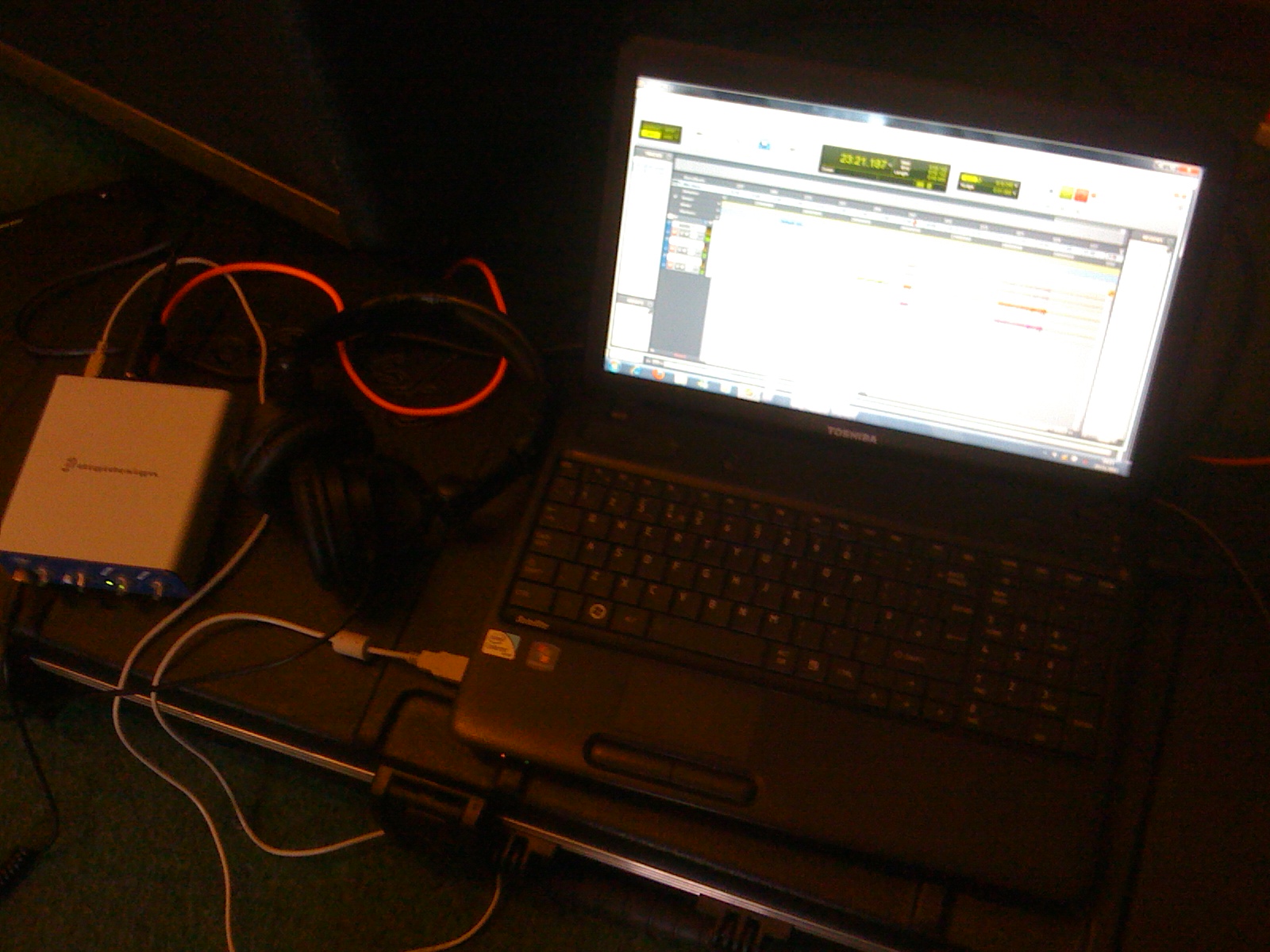
The fore-mentioned drum mics were ran into this desk, allowing us to set relative levels before taking these signals at the stereo output and running it into another m-box 2 sound card linked to a laptop running pro tools 8.


This image shows the fore-mentioned laptop.

The intention is to bring these 2 separate sessions together on laptop in order to mix them together and produce simple mixes in order to submit as part of post production, in order to justify many of the decisions I will be making in my floor plan, equipment list and microphone set-ups.

Tuesday, 22 November 2011

Pre Production - Planning Recording

Today I went and spoke the manager and owner of D.M. Studios, Tristan, (Dundee Music Studios) about carrying out the recording of my project in his studio in early February (due to availability of band).

He said this is entirely possible, however it will cost me around £100 for 6 hours or £150 for 10 (which I had previously suspected) and I may have to allow the in house sound engineer, Harris, to carry out the recordings. Even in this eventuality, I know from previous experience with Harris that I will still be allowed to place microphones and generally manage the session, leaving Harris to arm tracks and hit record.

Tristan has said if I go in on Thursday I will be able to photograph both the live room and studio space, allowing me to post them on this blog, as well as permitting me to create a detailed floor plan and planning out my microphone set up.

Sunday, 20 November 2011

Exhibition Presentation

This week I have been working on my contribution to my group presentation, and have created a mock up diagram, showing how I intend to lay out my exhibition space and explaining what everything is and why it's there.


The aim is to capture peoples attention with the interesting images of the poster with the EP artwork and the captioned photos. They will then be able to read all the necessary information from the walls of the exhibition, prior to listening to my recording, meaning they will understand the purpose of the recording before listening to them, and allowing them to inform themselves prior to asking any follow up questions.
I also intend to make more detailed literature available, should anyone wish for more information about my project.